
Confident Pose is a custom-engineered solution for posture improvement. We didn't settle for motion-only tracking. Discover how our intelligent dual-sensor system, featuring clinical-grade EMG muscle sensing delivers the accurate, personalized muscle data needed to truly improve your posture.
The Unmet Need: Why Existing Sensors Fall Short
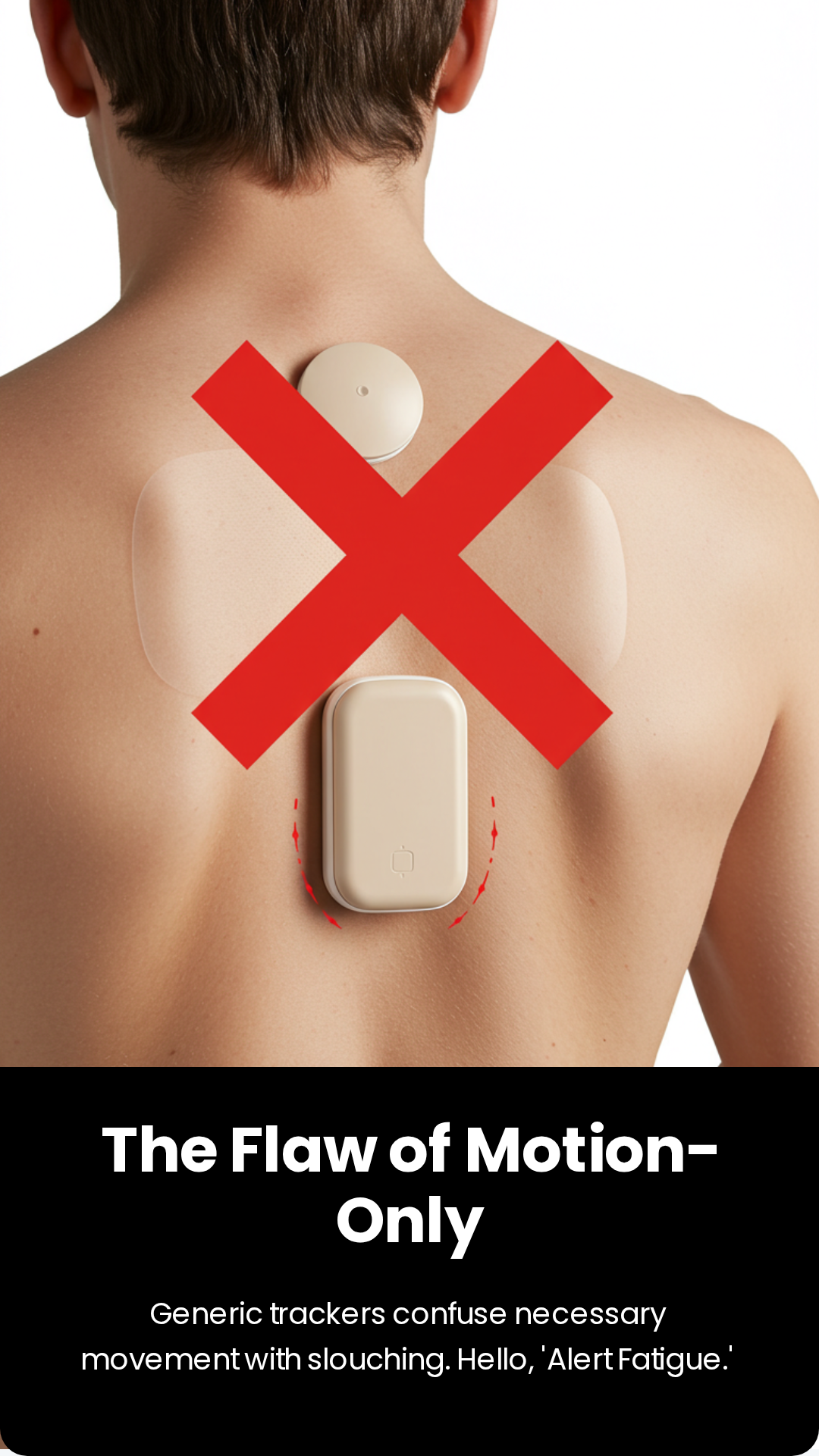
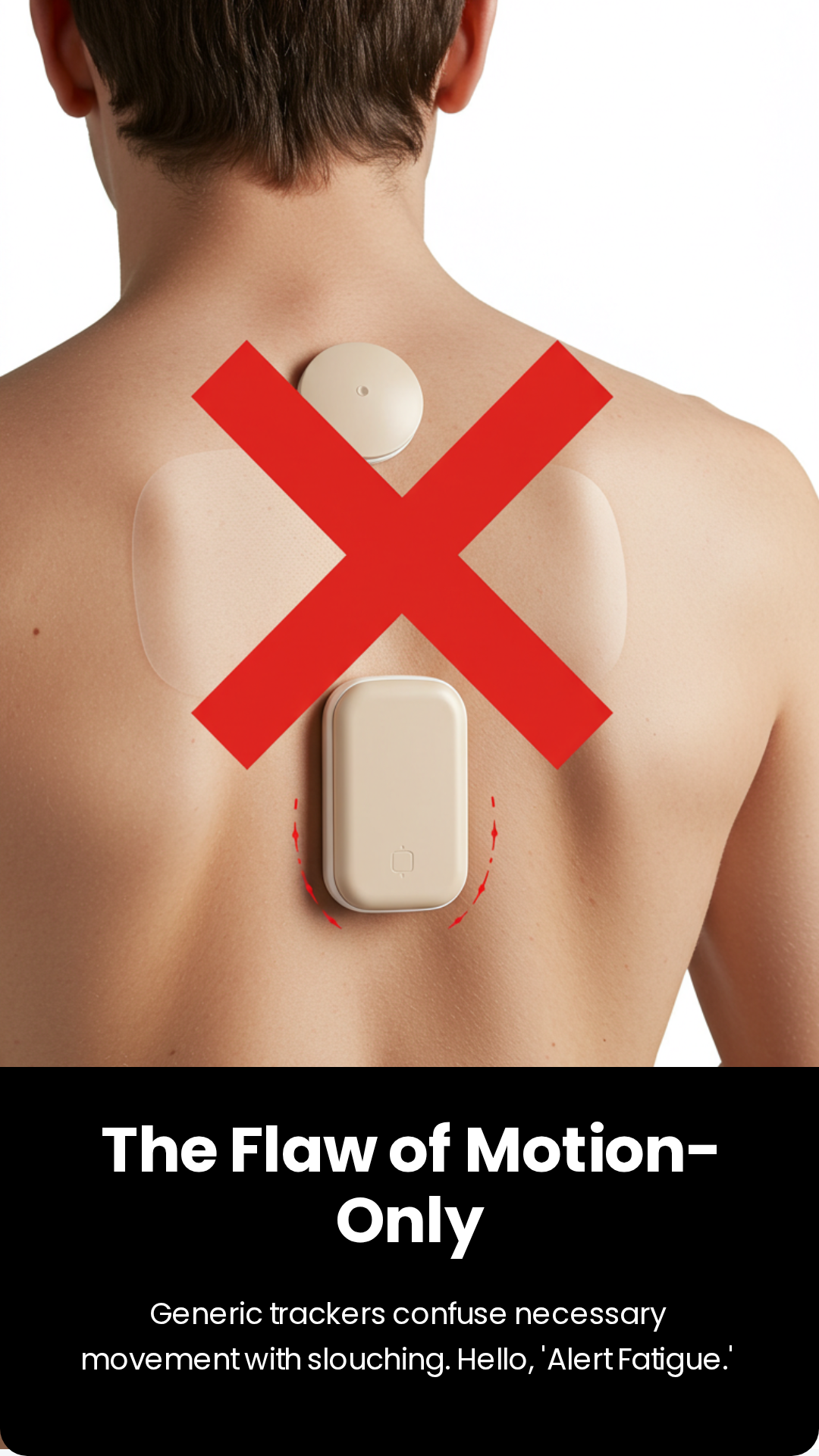
When we set out to build the ultimate tool to improve your posture, we recognized a critical flaw in all existing electronic wearables: they are built on a superficial understanding of the problem. Majority of posture gadgets rely solely on motion sensors (accelerometers or gyroscopes) to measure body orientation. While these sensors can detect a deviation in spinal alignment (a "slouch"), they suffer from two major drawbacks that lead to high user abandonment:
Inaccuracy and False Positives: Simple position trackers often trigger annoying alerts for normal, necessary movements, like bending to tie a shoe or leaning forward to write. This leads to "alert fatigue" and frustration.
Superficial Data: A motion sensor only tells you that you are out of position, but not why. It offers no insight into the underlying cause i.e., which muscles are weak or fatigued.
To truly deliver posture improvement, we knew we needed a device that could measure the physiological effort, not just the positional result.
The Custom-Engineered Solution: Dual-Sensor Fusion
To overcome the limitations of standard posture trackers, we at Confident Pose developed a custom-engineered system based on intelligent dual-sensor fusion. We integrated two distinct data streams to create an intelligent and accurate feedback loop:
Clinical-Grade EMG Muscle Sensor: This is our core differentiator. The EMG sensor (Electromyography) captures and processes the tiny electrical signals produced by your back muscles, specifically the trapezius region. This provides objective data on muscle activity sensor levels, muscle engagement, and, critically, muscle fatigue.
Precision Motion Sensor: This works alongside the EMG to measure orientation and body position, just as conventional devices do.
Through sensor fusion, we achieve higher accuracy in posture classification than conventional motion sensor-only devices.
Data-Driven Differentiation: Measuring Fatigue, Not Just Position
The power of integrating the EMG muscle sensor is that it directly addresses the core user problem: a lack of muscular endurance. Our system shifts the narrative from passive correction to active re-education. Here's what our advanced sensing system allows us to do that no standard motion tracker can:
Detect Fatigue, Not Just Slouching: The EMG sensor allows the system to detect the onset of muscle fatigue, the physiological process that leads to slouching. This means we can provide a corrective haptic cue before the user is completely out of position, encouraging active engagement at the precise moment their muscles are weakening.
Personalized Calibration: Our system uses a custom-engineered calibration methodology. During setup, you record your "good posture" and "bad posture". This establishes user-specific EMG baselines and dynamically adapts thresholds, ensuring your feedback is tailored to your unique muscle differences and physiology, significantly reducing false positives.
The Result: A Lasting Way to Improve Your Posture
This comprehensive hardware design - a thin, ergonomic module connected to a specialized adhesive electrode patch with a novel 3-zone configuration allows us to provide a complete solution: accurate monitoring, real-time haptic feedback, and structured training programs that promote the gradual strengthening of posture-supporting muscles.
We custom-engineered our sensing system because the only way to improve your posture is to measure what matters: your muscles.