
The Science of Confident Pose
Posture is more than how you look - it's how you function. Explore the biomechanics, neurology, and technology behind Confident Pose.
The "Text Neck" Epidemic: Physics of the Spine
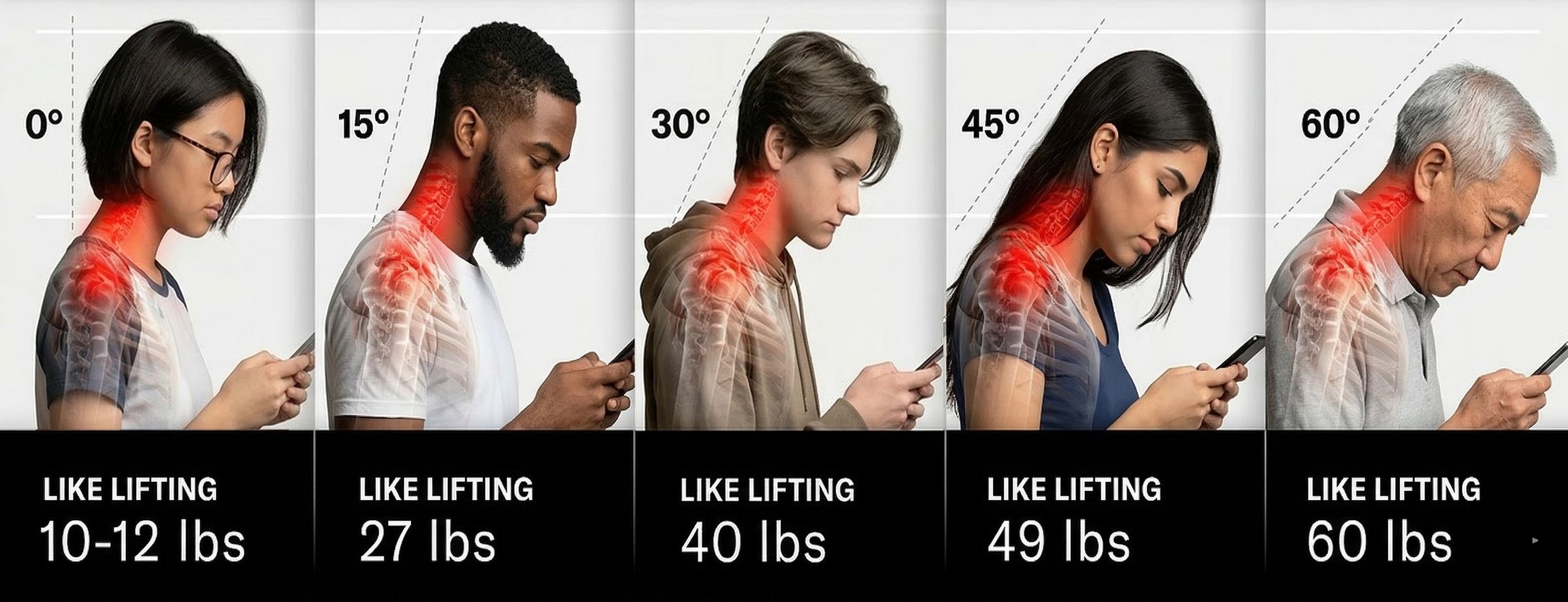
Your head weighs approximately 10-12 lbs. However, as your neck bends forward, the gravitational moment arm increases, dramatically amplifying the force on your cervical spine.
According to research by Dr. Kenneth Hansraj (2014), published in Surgical Technology International, this force can increase up to 60 lbs—equivalent to carrying an 8-year-old child around your neck.
Why this matters:
- ● Accelerated degeneration of spinal discs.
- ● Chronic tension headaches and suboccipital pain.
- ● Reduced respiratory capacity due to compressed rib cage.
Cervical Spine Stress Load
Source: Hansraj, K. K. (2014)Click the bars above to see the impact.
What these angles look like in real life
Beyond Back Pain: The Systemic Impact
Posture doesn't just affect your spine; it regulates your nervous system, hormones, and cognitive performance.
Cognitive Performance
Upright posture has been linked to higher self-esteem, better mood, and improved resilience to stress compared to slumped postures.
Pain Perception
Poor posture activates "trigger points" in the trapezius and suboccipital muscles, a primary cause of tension-type headaches.
Energy & Fatigue
Slouching compresses the diaphragm, reducing lung capacity and oxygen intake, leading to earlier onset of mental and physical fatigue.
Sensor Data Stream
Feedback Status
Why Motion Sensors Aren't Enough
Traditional posture correctors rely solely on accelerometers (motion sensors). They only know if you are vertical. They don't know if you are holding that position with your muscles or just hanging on your ligaments.
Confident Pose is different. We use Electromyography (EMG) to measure actual muscle activation.
The "Passive" Trap
You can sit straight but totally relaxed. This stresses your spine ligaments (creep deformation). Motion sensors think this is fine. Confident Pose knows it's not.
Active Stabilization
True good posture requires micro-engagements of the lower trapezius and rhomboids. Our EMG sensor detects this "hum" of activity.
Research Archive
Explore the primary literature supporting our methodology.